- Introduction to sex crimes and the registry
- Characteristics of registrants
- Kids on the registry
- Sentencing for sex crimes
- False accusations
- Life on the registry
- Sexual civil commitment
- Other legal issues
- Effects on our society
- Initiatives for change
Introduction to sex crimes and the registry
 1. What is a sex crime registry?
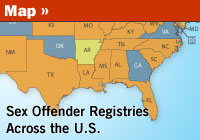
Map of sex crime registries in the USA.
Source: National Center for Missing & Exploited ChildrenA sex crime registry is an official government listing of people who have been convicted of certain crimes of a sexual nature. (While this is often called a “sex offender registry,” see why that term is not used here.) There are registries in every US state and six other countries, although the United States is the only place where the information is publicly available on the Internet. The first major registry was established by California in 1947; most other US states set theirs up in the mid-1990s.
For more information, see the SOLR report, Introduction to the Sex Crime Registries.
—————Note posted on January 24, 2008, updated January 28, 2009.
 2. How many people are there on the registry?
Sex crime registries have been created in all 50 states of the USA, as well as the District of Columbia, Puerto Rico, Guam, other territories and possessions, and several foreign countries. How many people are listed on these registries? The only honest answer to that question is that nobody really knows, but there are a lot. The US government isn’t counting, and the states and citizen groups are wildly over-counting. Many registries include large numbers of people who have been dead for many years and others who no longer live in the states that are listing them. Despite this, it is still true that there are a lot of real people on the registries. A reasonable estimate for the United States is probably in the neighborhood of 550,000. Approximately one out of every 220 adult men in the country is on the registry.
For details and analysis of the numbers, see the SOLR report, Counting and Over-Counting the Registry.
Additional details regarding “noncompliants”:The number of people being sought for registration in the United States is largely included in the number of people on the registries because most jurisdictions include them on their registries as “noncompliants.”
Additional details regarding incarcerated population:The registries include a good number of people who are currently incarcerated (see the SOLR report, Counting and Over-Counting the Registry), but there may be over 200,000 people currently in prison for sex crimes who are not yet on the registries.
US government statistics indicate there were 154,000 people in state prisons at the end of 2004 whose most serious crime was rape or other sexual assault.1 The same source also shows that the federal prison population is about 14% that of the state prisons,2 so if the crime ratio is similar, this would imply a total of about 175,000 people in federal and state prisons for sex crimes. Add to this prisoners who committed sex crimes along with more serious crimes, people imprisoned for sex crimes not classified as sexual assault, people incarcerated in non-prison facilities (mainly jails and juvenile detention3), and growth in prison population since 2004, and the total number of people incarcerated for sex crimes probably well exceeds 200,000.
There is an unknown amount of overlap between the population on the registries and that in prisons for sex crimes, but that overlap is not likely more than ten to 20 percent.4 Thus it is likely that the total number of people who are either registered or incarcerated, or both, in the United States for sex crimes is in the neighborhood of 750,000.
Summary:As discussed in the SOLR report, Counting and Over-Counting the Registry, there are no reliable data on the number of people on the registry in the United States. Published estimates exceeding 600,000 are likely exaggerated. The correct number of people on the US registries is probably in the neighborhood of 550,000. This includes anyone on parole for a sex crime and satisfying their parole requirements. It also probably includes most people being sought for registration because most jurisdictions include on their registries such “noncompliants” who have either never registered or have failed to renew their registrations. It also includes a significant (but unknown) number of people who are currently in prison. However, we can add in some 200,000 people who are in prison and not on the registry, for a total of about 750,000 people convicted of sex crimes who are either on the registry, in prison, or both.
1. Prisoners in 2006, Bureau of Justice Statistics (US DoJ), December 2007 (Link), Appendix table 9, page 242. Same, Table 1, page 23. See same, inset at bottom of page 3, Total incarcerated population at yearend 2006.4. See figures reported in the SOLR report, Count Analysis of the US Registries.
——————————
—————Note posted on August 24, 2007, updated September 20, 2007, January 28, 2009.
Characteristics of registrants
3. Should I care about people on the registry? Aren’t they all “perverts” and sexual deviants?It’s easy to be complacent about sex laws — until one of them comes crashing down out of the blue on top of you or someone in your family. Unfortunately, it’s becoming easier and easier all the time for that to happen — with behaviors that most people consider perfectly healthy and acceptable, like breastfeeding or taking innocent pictures of their own babies in the buff. See the SOLR report, Look Who’s on the Registry Now!, for some heartbreaking examples.
—————Note posted on August 24, 2007, updated January 10, 2008, January 28, 2009.
4. Are most people on the registry child molesters?According to § 628(a)(11) of the Adam Walsh Act, 56 percent of victims of sexual assault are 18 or older. The act does not cite a source for this statistic. If correct, it would indicate that more sexual assaults are committed against adults than against children and adolescents.
Contrary to that, an initial analysis of the records of the 11,142 people on the public registry in Los Angeles County on April 14, 2008 shows that 7,447 of them (67 percent) are registered as a result of crimes whose descriptions indicate sexual activity with a juvenile. Of the total of 14,276 crimes shown on the registry for those individuals, the descriptions of 8,124 of them (57 percent) indicate sexual activity with a juvenile.
—————Note posted on August 24, 2007, updated January 10, 2008, January 28, 2009.
5. Are people on the registry dangerous criminals that need to be kept away from children?Some are. But many are not, unless you think breastfeeding your baby or taking a pee behind a dumpster makes you that dangerous!
Source: National Public Radio National Public Radio analyzed the sex crime registries1 in April 2006 to determine what kind of people are included on their public websites. It found that while 23 states only show those who are considered dangerous or have repeat convictions, 25 states “list such criminals alongside people who may pose no risk to the public.”
See the SOLR report, Look Who’s on the Registry Now!, for examples of fairly ordinary people who got caught doing fairly ordinary things that got some of them put on the registry.
See also Q&A # 6 below for information on registries that include those convicted of public urination, “streaking,” and “mooning.”
1. Murders Put Focus on Sex-Offender Registry Policies, All Things Considered, National Public Radio (U.S.A.), April 21, 2006 (Audio report)
——————————
—————Note posted on August 24, 2007, updated January 10, 2008.
 6. Can someone really be on the registry for public urination?
Yes.
Public urination is typically charged under “indecent exposure” statutes, which also cover mischievous pranks, such as “streaking” and “mooning.” Here are some examples of people on the sex crime registries for such innocuous crimes.
- A Colorado man is on that state’s registry because of his conviction for a bout of drunken nudity in his own backyard in 2002. (See Absurdity Breakout: Laws end up targeting not-so-dangerous 'sex offenders', GateHouse News Service, August 20, 2007.)
- A Pennsylvania man is on his state’s registry for “streaking.” (See State Registration Laws in No Easy Answers: Sex Offender Laws in the US by Sarah Tofte with research by Corinne Carey, Human Rights Watch, September 12, 2007.)
- Juan Matamoros pleaded guilty to public urination in Massachusetts in 1986. Because of that, 21 years later, he must move from the Florida home his family lives in because it is too close to a city park. (See Sex offender ordinance catches family in legal tangle, News-Journal (Daytona Beach, Florida), March 2007.)
- A Chicago construction worker who relieved himself behind a garbage can in an alley was spotted by a police officer, arrested, and convicted of public urination and indecent exposure. As a Mexican immigrant, he was later rounded up for deportation by Homeland Security’s “Operation Predator.” (See Immigrant sex offenders targeted (2°), Chicago Tribune, February 24, 2005.)
- Nancy Phipps was convicted of flashing a detective and will be on Oklahoma’s registry for that until 2012. In 2007, she moved into a homeless shelter with her 16-year-old daughter because residency restrictions barred her from 90 percent of the city they live in. (See Absurdity Breakout: Laws end up targeting not-so-dangerous 'sex offenders', GateHouse News Service, August 20, 2007.)
- In 1973, the California Supreme Court allowed James Birch to retract his plea of guilty to public urination because he did not know when he entered it the year before that it would make him subject to lifelong registration. (See case 10 Cal. 3d 314.)
In 2007, Human Rights Watch found thirteen states that require sex crime registration for public urination. While two limit the requirement to cases in which it was done in view of a minor, the other eleven states have no such limitation.
—————Note posted on January 10, 2008, updated January 15, 2008, January 24, 2008.
7. Do pedophiles attack children brutally when they can, and then kill them?While some people consider any kind of sexual activity with a child intrinsically violent (see also Q&A # 36 below), numerous psychological studies have found that sexual activity with children is rarely violent in the sense that no force is used. For example:
Sex offenders against minors … were found for the most part to be non-violent and not aroused by sexually aggressive stimuli involving children … 26 studies conducted over the past 40 years have found that adult-child sexual activity rarely involves force or violence. … Some studies … showed that they were significantly more aroused by consensual stimuli than by those involving force.
From Personality Correlates of Pedophilia: Are They Reliable Indicators? by Paul Okami and Amy Goldberg, Department of Psychology, University of California, Los Angeles, Journal of Sex Research, Society for the Scientific Study of Sexuality, August 1992 (abstract and buy) Other studies reporting similar findings include:
- Theory-based assessment, treatment, and prevention of sexual aggression by Gordon C. Nagayama Hall, Kent State University, Ohio, 1996 (Google Books)
- Sexual encounters between boys and adults by Donald J. West and T. P. Woodhouse, Institute of Criminology, University of Cambridge, England, 1990 (pg 3..137)
- The heterogeneity/homogeneity of pedophilia by J.M.W. Bradford, B.A. Bloomberg, and D. Bourget, Forensic Service, Royal Ottawa Hospital, Psychiatric Journal, University of Ottawa, 1988 (PubMed)
See also the SOLR report, Discerning Use of Force in Sexual Crimes.
—————Note posted on January 10, 2008, updated January 16, 2008, May 11, 2008, January 28, 2009.
8. What is the medical definition of a pedophile?A pedophile is defined medically as a person primarily attracted to children who have not reached puberty (about age 12). See Diagnostic criteria for … Pedophilia in Diagnostic and Statistical Manual of Mental Disorders, Fourth Edition, Text Revision (DSM-IV-TR), American Psychiatric Association, 2000.
—————Note posted on January 10, 2008, updated January 16, 2008.
9. Is it true that most sexual activity with children is done by their family members, and not by strangers?Several government studies have shown that most sexual activity with children and adolescents is by family members, not strangers. The same is also true of physical injury and (intrinsically) neglect. See the SOLR report, Family and Strangers, for reviews of the data from some of these studies.
—————Note posted on January 10, 2008, updated January 24, 2008, January 28, 2009.
10. Are people convicted of sex crimes likely to do it again?(Entry coming soon.)
—————Note posted on September 20, 2007, updated September 26, 2007, January 10, 2008, January 28, 2009.
Kids on the registry
11. Do kids who are just “messing around” have to worry about these laws?Yes, they do.
11-year-old on the sex crime registry What used to be called “playing doctor” for young children or thought of as normal sexual experimentation for older teens is now enough to get a kid arrested, taken away in handcuffs, put in juvenile jail (or sometimes even adult prison), subjected to draconian psychological “treatment,” and put on a sex crime registry, often for the rest of his or her life! This is not just for aggressive or violent behavior, but also for innocent, consensual play among giggling kids. See the SOLR report, Criminalizing Child’s Play, for data on the formal admonishment of children as young as four, and criminal prosecution of first graders, for innocent sexual behavior.
See also Q&A # 13 below for information on the youngest children on the registries.
—————Note posted on August 24, 2007, updated January 28, 2009.
 12. How young are kids getting into trouble for innocently “messing around”?
A four-year-old has been charged with sexual harassment for hugging his teacher, and two first graders have been prosecuted for sodomy as a result of innocent, mutual play with each other.
Here are some example cases of young children being formally admonished or legally prosecuted for innocent and playful sexual activity:
- 4-year-old suspended after hugging teacher's aide, Associated Press, December 11, 2006
- Girl, 5, Forced To Apologize For Hugging Classmate — Parents Looking For New School For Girl — WCVB-TV (Boston, Massachusetts), April 5, 2006
- Boy, 5, Accused Of Sex Harassment For Pinching Girl’s Butt (☀) — Boy’s Father Says He Can’t Explain Term — NBC4.com (Maryland), December 20, 2006
- Kindergartners Accused of Having Sex at School (☀), KGBT-TV (Harlingen, Texas), April 19, 2005
- 6-Year-Old Boys Caught Having Sex At Day Camp, WESH-TV (Orlando, Florida), July 11, 2006
- 6-Year-Old Accused Of Sexual Harassment — Boy Accused Of Putting Fingers In Girl’s Waistband — KMGH-TV (Denver, Colorado), February 8, 2006
- Boy, 6, accused of sex abuse, The Age (newspaper) (Melbourne, Australia), September 19, 2007
- First Graders Face Sodomy Charges, WFIE-TV (Evansville, Indiana), February 10, 2005 (Date obtained by searching for title on the website (see cache of article).)
Note that while in the case reported by KGBT-TV, authorities were content with giving the boys counseling and school suspension, prosecutors in the case reported by WFIE-TV actually filed first degree sodomy charges against two first graders who were “found in the bathroom performing sexual acts.”
For many more cases like these, see the SOLR report, Criminalizing Child’s Play.
—————Note posted on January 10, 2008, updated January 28, 2009.
13. How old are the youngest people on the registry?The public registries in the US include children as young as eleven years old.
11-year-old on the sex crime registry The photograph on the right was taken — without the bar across the boy’s eyes — from an actual entry on the registry website. We do not provide a link here to the entry in order to protect the privacy of the boy and his family. Along with his full name and street address, the registry gives his date of birth and date first registered, indicating he was put on the registry at age eleven. It also indicates that his crime was “Aggravated indecent liberties with a child,” which, in the boy’s state, is a felony that includes consensual sexual touching of another child under 14 years of age.
This boy is one of six eleven-year-olds who were found in an analysis in 2007 of the registry data for four US states (Colorado, Georgia, Idaho, and Kansas) that include juveniles and dates of birth on the public registry. That analysis showed almost a thousand people under the age of 18 on the public registries in just those four states. See the SOLR report, Criminalizing Child’s Play, for more information on that analysis.
There is also a case in England of an 11-year-old boy being put on the registry for a crime committed when he was ten. See Boy, 11, on sex register, Liverpool Echo (United Kingdom), May 12, 2006.
—————Note posted on January 10, 2008, updated January 28, 2009.
14. Is psychological counseling appropriate for kids who get caught being sexual?Sometimes it is, but often it is not. Sometimes the children's behavior is comletely appropriate to their normal age and development and any such counseling may be harmful for both so-called “perpetrators” and “victims.” Even when the children's behavior was overly aggressive or otherwise inappropriate, the type of psychological treatment used is often abusive and harmful to the further development of the children. In particular, juveniles whose feelings or actions are considered deviant are often subjected to the same aversive therapies once used to “cure” gay men.
The psychological treatments used on children who are caught being sexual are discussed in the Treatment section of Ethical Treatment for All Youth. Abusive treatments that were commonly used on homosexuals in the 1950s and are currently used on children are discussed on that site under Arousal Reconditioning.
—————Note posted on January 10, 2008, updated January 28, 2009.
15. But we can’t just let kids run amuck. We have to do something to punish unruly children.There are two questions to consider in relation to sex crime registration of juveniles.
- Is it right to use the legal system to punish children and teenagers for engaging in consensual sexual activity with other kids? After punishing them, does it make any sense to put these kids on a public registry, warning the community that they are dangerous?
- In cases where kids used force or violence in sexual ways, is it right to punish them much more severely than others who used force and violence nonsexually? Kids who bully their peers, set fire to buildings, or even kill somebody are punished, counseled, and then released into the community with no public scrutiny of their whereabouts or dealings.
For nonsexual, violent crimes handled in juvenile court, the records are sealed after a period of time and the people can go on to work as teachers, doctors, or police officers. Nobody needs to know about their youthful crimes. But if those crimes involved touching the genitals of another child, either with permission or not, then the criminal records are, far from being sealed, broadcast on the Internet for all the world to see. When they reach adulthood, these people can never take jobs that involve working with children and in some states may be barred from living with their own children, should they be lucky enough to find someone willing to have a family with them.
—————Note posted on January 28, 2009, updated January 28, 2009.
16. Can a juvenile be put in civil commitment for a sex crime?The New York Times reported in 2007 that two states have civil commitment inmates as young as 18 years old. To be in civil commitment by the age of 18, one must have committed the associated crimes as a juvenile. In six other states, the youngest civil commitment inmates are aged 21 or less. Because of the time that it takes for a person to become committed, it is likely at those ages as well that the crimes involved were committed entirely in the juvenile years. See A Profile of Civil Commitment Around the Country, New York Times, March 3, 2007.
—————Note posted on January 10, 2008, updated January 28, 2009.
Sentencing for sex crimes
17. When people are sent to prison for a sex crime, aren’t they just getting what they deserve?Since the late 1900s, America has become an increasingly punitive society that sees fit to lock up its people — now almost one percent of us. People convicted of sex crimes are the latest category of villains for whom no sentence seems too harsh. The US federal sentencing guidelines make it official that photographing a 17-year-old boy with an erection earns a penalty about twice as severe as attempting to kill him — and about four times as severe as beating him up so badly that he accidentally dies.
See the SOLR report, Sex Crime Sentencing, for factual background on this issue.
—————Note posted on August 24, 2007, updated January 10, 2008.
18. Can someone get the death penalty for a nonviolent sex crime?As of June 2008, six US states had passed legislation allowing the death penalty for non-murder cases of sexual activity with a juvenile: Georgia, Louisiana, Montana, Oklahoma, South Carolina, and Texas. Those laws have now been struck down by the US Supreme Court.
The first law that did this was in Louisiana:
Aggravated rape. Whoever commits the crime of … anal, oral, or vaginal sexual intercourse … [where] it is deemed to be without lawful consent of the victim because … the victim was under the age of thirteen years … [and where] lack of knowledge of the victim’s age shall not be a defense …, if the district attorney seeks a capital verdict, the offender shall be punished by death or life imprisonment at hard labor without benefit of parole, probation, or suspension of sentence, in accordance with the determination of the jury.
From Louisiana Revised Statute 14:42, as amended by House Bill 55 (☀) in 1995,1 sections A(4) and D(2)(a) So stated, a woman could be put to death for allowing a twelve-year-old boy to penetrate her.
The law was upheld by the Louisiana Supreme Court in 2007, but was then struck down in June 2008. The US Supreme Court ruled that capital punishment for crimes against individuals could only be used in cases of murder.
For more on this issue, see the following references.
- Louisiana jury sentences a man to death for non-murder crime, Champion Magazine, National Association of Criminal Defense Lawyers (U.S.A.), November 2003
- Better Dead than R(ap)ed?: The Patriarchal Rhetoric Driving Capital Rape Statutes by Corey Rayburn Yung, St. Johns Law Review, September 2004
- Louisiana v. Patrick Kennedy, Louisiana Supreme Court, May 22, 2007. The validity of the above law is discussed in the section on Capital Punishment for Non-Homicide Aggravated Rape on page 37 to 59. See also the dissenting opinion of Chief Justice Calogero in the last two pages of the same file.
- States Move to Enact Laws Allowing the Death Penalty for Pedophiles — A Good Sign with Respect to Public Dedication to Protecting Children, But Potentially Not the Most Effective Way to Do So — Writ, FindLaw, May 31, 2007
- Kennedy v. Louisiana (2°) by Anthony Kennedy, dissent by Samuel Alito, US Supreme Court, June 25, 2008 (Link. 554 U.S. ___, Argued 2008 04 16, decided 2008 06 25, modified 2008 10 01)
- Child rapists can't be executed, Supreme Court rules, CNN, June 25, 2008
- Toobin: Death penalty will be reserved for murderers, CNN, June 25, 2008
——————————1. House Bill 55 gives the age of the victim for the death penalty to apply as “under the age of twelve years,” whereas Statute 14:42 gives it as “under the age of thirteen years.” Presumably, there was an amendment that raised the age by a year after passage of House Bill 55.
—————Note posted on August 24, 2007, major revision on May 11, 2008, September 7, 2008, updated January 28, 2009.
False accusations
19. Do our laws effectively protect innocent people?There are three ways that innocent people get to be treated as criminals:
- When accusations of sexual activity are assumed to be true without due process of law and they turn out to be false, innocent people suffer. See the SOLR report, False Accusations of Sex with Juveniles, for examples of this happening.
- Some people have become so fearful that they may see sexual abuse in perfectly innocent behavior, such as breastfeeding and taking naked baby pictures. See the SOLR report, Look Who’s on the Registry Now!, for examples, as well as Q&A # 5 above and Q&A # 6 above.
- In the UK, police have been given authority to monitor and enter the homes of people who have not been convicted of any crime, but are suspected of having an attraction to children. See New Crackdown on Paedophiles, Daily Express (United Kingdom), July 30, 2007.
—————Note posted on August 24, 2007, updated September 20, 2007, January 10, 2008, January 16, 2008.
20. Have all people on the registry been found guilty of sex crimes fair and square under due process of law?Not necessarily. A number of legal scholars have expressed concern that basic human rights at the core of the United States Constitution have been eroded by recent actions of the U.S. federal and state governments. The following are some examples of concerns raised by reputable sources.
On rules of evidence
The Michigan state senate has passed, and the state’s governor has promised to sign, a bill that would alter the rules of evidence in criminal trials. The bill provides that in criminal trials for sexual abuse of a minor, a defendant’s prior convictions for similar acts would be admissible as evidence that the defendant is guilty of the crime charged in the current case.
The bill will likely soon become law in Michigan, and an increasing number of states have passed comparable statutes. These statutes are significant, for the decision to admit such evidence against a criminal defendant represents a sharp departure from the usual approach, an approach that reflects the concern that hearing about prior crimes could unfairly prejudice a jury against the accused.
From Michigan's Proposed Law Admitting Prior Crimes in Child Sex Abuse Cases: Why It Has Broader Implications for the Law of Evidence by Sherry F. Colb, Writ, FindLaw, September 21, 2005 For a case in which this new law came into play, see Gratiot postal worker convicted of sex crime, Morning Sun (Mt Pleasant, Michigan), March 9, 2006.
On ex post facto laws
Assembly Speaker Sheldon Silver … said last week that the retroactive nature of the [Megan’s Law] bill [establishing a public sex crime registry] was “a clear flaw.” But today Mr. Silver said he had decided to support the bill anyway and would let the courts determine its constitutionality. With the Assembly Democrats feeling vulnerable on crime issues, particularly after [Republican governor] Pataki’s victory last November, Mr. Silver clearly faced intense political pressure not to oppose the bill.
From Bill to Track Sex Offenders Nears Passage, New York Times, June 27, 1995. See also Q&A # 38 below.
On the statute of limitationsSee Q&A # 39 below.
On search and seizureOn privacy
The seizure of electronics [by US Customs agents] has prompted protests from travelers who say they now weigh the risk of traveling with sensitive [corporate] or personal information on their laptops … [The executive director of the Association of Corporate Travel Executives said] “People are quite concerned. They don’t want proprietary business information floating, not knowing where it has landed or where it is going.” … “It’s one thing to say it’s reasonable for government agents to open your luggage,” said David D. Cole, a law professor at Georgetown University. “It’s another thing to say it’s reasonable for them to read your mind and everything you have thought over the last year. What a laptop records is as personal as a diary but much more extensive.” … [A] technology security expert … and … former federal prosecutor [said,] “Lawyers run the risk of exposing sensitive information about their client. Trade secrets can be exposed to customs agents with no limit on what they can do with it.”
From Clarity Sought on Electronics Searches — U.S. Agents Seize Travelers' Devices — Washington Post, February 7, 2008 On general erosion of civil rights
Privacy no longer can mean anonymity, says Donald Kerr, the principal deputy director of national intelligence. Instead, it should mean that government and businesses properly safeguard people’s private communications and financial information.
From Intelligence deputy to America: Rethink privacy (2°), Associated Press, November 11, 2007
America is in a state of constitutional crisis engendered by the president’s unprecedented expansion of executive power. The crisis is exacerbated by the 109th Congress’s failure to carry out its constitutionally mandated role to act as a check on the executive.
From The 2007 State of Civil Liberties in America, American Civil Liberties Union, January 22, 2007 See also Safe and Free: Restore our Constitutional Rights, American Civil Liberties Union.
[T]he United States has enacted or begun to undertake new laws, policies, and practices that reflect the continuing failure of the U.S. to fulfill its obligations under the ICCPR [International Covenant on Civil and Political Rights]
From Supplemental Submission to the Human Rights Committee, Human Rights Watch, June 2006 That report documents eleven problem areas, including secret detention, indefinite detention, and sentencing juveniles to life in prison without the possibility of parole.
The following list provides links to the official text of some key laws and bills that have been cited to be of concern.
- Military Commissions Act of 2006, US Congress, October 17, 2006 (S. 109-3930, Public Law 109-366). This law eliminated the right of aliens to habeas corpus (freedom from unlawful imprisonment)
- National Continuity Policy — National Security Presidential Directive 51 and Homeland Security Presidential Directive 20 — by George W. Bush, May 9, 2007
- Blocking Property of Certain Persons Who Threaten Stabilization Efforts in Iraq: Executive order by George W. Bush, July 17, 2007
- Protect America Act of 2007, US Congress, August 5, 2007 (S. 110-1927, Public Law 110-55)
- Violent Radicalization and Homegrown Terrorism Prevention Act of 2007, US Congress, October 24, 2007 (Date passed in House) (H.R. 110-1955 and S. 110-1959)
—————Note posted on August 24, 2007, major revision on May 11, 2008, updated January 28, 2009.
21. Are many people falsely accused of rape?Yes. Ironically, rape is both under-reported and over-reported. This seemingly self-contradictory fact arrises from the following two circumstances:
- Under-reporting and false acquittals. A victim of rape may be ashamed to talk about the incident with anyone at all, let alone with the police. The victim may be ashamed of behavior that might have contributed to or incited the act. Even when there was no such behavior, many cultures treat rape victims with suspicion and disdain. Furthermore, if the victim is willing to talk about it, she or he may still be afraid of harsh treatment by police and in the court system. There also may be significant fear of retaliation by the rapist if the crime is reported. For these reason, many victims decide not to report the crime to police. Even after reporting a legitimate rape, victims may change their minds and decide not to cooperate with the investigation or not to testify in court, effectively blocking prosecuton of the crime. Still another factor is that rape can, depending on the circumstances, be difficult or impossible to prove, which can lead to false acquittals when juries don't have enough evidence to convict.
- Over-reporting and false convictions. A person may fabricate a rape scenario in order to retaliate against a lover, to cover up shame of having consented to sex, to fake an alibi for one's own criminal act, or to seek sympathy and attention.1 Just as rape can be hard to prove, it can also be difficult or impossible to disprove, and juries will sometimes sympathize with an accuser telling a tearful story, even in the absence of evidence and even against a solid alibi of the defendant. In cases of rape by a stranger, the victim may unwittingly misidentify an innocent person as the rapist, especially is they are of different races.
These two sets of factors are entirely unrelated and they work against each other to make many accusations of rape very difficult to evaluate. To make matters worse, research on the subject is usually biased in favor of one side or the other. Proponents of victims' and women's rights tend to emphasize the incidence of under-reporting and false acquittals and belittle evidence of over-reporting and false accusations. Conversely, proponents of defendants' and men's rights are more prone to skew matters in the opposite direction. The fact is that both phenomena occur to a substantial degree and both need to be taken into account. For a balanced discussion of both the difficulties of and the need for impartial analysis, see The Elusive Numbers on False Rape by Dick Haws, Columbia Journalism Review, November 1997.
See the following references for information on false accusations and false convictions of rape:
- False Allegations of Rape by Philip N.S. Rumney, Cambridge Law Journal, April 2006 (Link is to abstract and buy link)
- Study Suspects Thousands of False Convictions, New York Times, April 19, 2004
- Excluded Evidence: The dark side of rape shield laws, Reason, February 2002
- Crying wolf (2°) — In a system that assumes children don't lie and women are victims, false allegations happen with alarming regularity and frequency — by Christie Blatchford, National Post (Canada), September 8, 2001
- Convicted by Juries, Exonerated by Science: Case Studies in the Use of DNA Evidence to Establish Innocence After Trial by Edward Connors, Thomas Lundregan, Neal Miller, and Tom McEwen, National Institute of Justice (US DoJ), June 1996 (Link)
- False Rape Allegations (2°, 2°) by Eugene J. Kanin, Archives of Sexual Behavior, International Academy of Sex Research, February 1994
See also Q&A # 22 below for the related issue of false accusations of having sex with a juvenile, as well as the Note on under-reporting and over-reporting in the SOLR report, How Children are Harmed.
1. False Rape Allegations (2°, 2°) by Eugene J. Kanin, Archives of Sexual Behavior, International Academy of Sex Research, February 1994
——————————
—————Note posted on January 28, 2009.
22. Are many people falsely accused of having sex with a juvenile?Yes, many. It’s impossible to know exactly how many, but by looking at cases where it has almost certainly happened, one gets the impression that it’s not rare.
(The question being answered here is specific to alleged sex with a juvenile. Regarding false accusations of rape, see Q&A # 21 above.)
In courtrooms across the United States and around the world, children are called to testify against their parents, teachers, neighbors, or strangers for having sexual contact with them. This is an unfortunate but often important burden to place on a child in order to protect other children from inappropriate behavior. But when the alleged activity never took place, or was done by somebody else, the coaxing or coercion of children to provide false testimony can only be a painful experience, especially when those children then carry the guilt of sending an innocent person to prison.
See the SOLR report, False Accusations of Sex with Juveniles, for a collection of over 150 cases of claims that innocent people have been falsely accused of sexually molesting children. Where possible, they are presented with links to court documents and reputable news reports and analyses to allow readers to determine for themselves if they believe justice has been served in these cases.
—————Note posted on August 24, 2007, updated September 20, 2007, April 23, 2008.
23. Does something have to be seriously wrong before a sex crime would be reported to the police?Not necessarily. In what used to be confidential settings, mandatory reporting laws in the US now require doctors, therapists, teachers, other professionals, and, in some states, "any person" to report to the police any mention of past, present or possible neglect or injury of, or sexual activity with, a juvenile.
See Mandatory Reporting of Child Abuse and Neglect by Susan K. Smith, Smith & Moore, LLC, August 25, 2007.
—————Note posted on January 10, 2008, updated January 28, 2009.
24. Can someone be prosecuted based on a witness’s “recovered memories”?(Entry coming soon.)
—————Note posted on August 24, 2007.
Life on the registry
25. Can people live okay on the registry if they just stay out of trouble?An anonymous website maintains an ominous list of hundreds of suicides, murders, and other inauspicious deaths of people who committed sex crimes, or those falsely presumed to have done so. See The Consequences, of sex laws, sex crimes and accusations!: Suicides, Deaths, Murders, and Revenge by “eAdvocate”. Click on the link in each death listed to be taken to a news report about it in the mainstream press.
Here are some examples of vigilante attacks over the years, half of which resulted in the death of one or more registered people trying to stay out of trouble, or else the death of innocent bystanders or the vigilante attacker. In cases marked with an asterisk (*), the vigilantes attacked an innocent person by mistake.
- Megan's Law listing may have led to slaying (1°) — Lake County prosecutors have investigated the possibility that information in the Internet database might have been the motive for the killing of a convicted sex offender. — Los Angeles Times, December 10, 2007 and Murder May Be Tied to Online Sex Offender List, All Things Considered, National Public Radio (U.S.A.), December 28, 2007 (Audio report)
- * Pleas in what cops call vigilante fire, Associated Press, October 8, 2007 — A fire was set in a small town in Tennessee, intended to scare off a man who’d been charged with possessing child pornography, but the fire killed the man’s wife instead.
- Angry neighbors descend upon registered sex offender, New Hampshire Union Leader (Manchester, New Hampshire), August 14, 2007
- * Man 'thought neighbours were pedophiles', News Network (Australia), June 8, 2007 — So he killed them!
- Police investigate alleged gunman's motives in killings, Boston Globe, April 18, 2006, Sex Offender Registries: Putting Lives At Risk? — Double Murder of Maine Men Sparks Debate About Online Sex Registries — ABC News, April 18, 2006, and Stephen Marshall stalked more sex offenders, police say (1°), CBC News (Canada), April 24, 2006
- Killings of 2 Bellingham sex offenders may have been by vigilante, police say, Seattle Times, August 30, 2005 and Vigilante Used Web Site to Find Sex Offenders, Day to Day, National Public Radio (U.S.A.), September 7, 2005 (Audio report)
- Police Shoot, Kill Man — Garcia Killed After Refusing To Surrender — KERO-TV (Bakersfield, California), February 23, 2004 — Here, the man killed by police was wielding a knife and kicking in the front door of a registered person who lived down the street from him.
- * Plain stupid: British vigilantes mistake a pediatrician for a pedophile., Salon, September 26, 2000
- Paedophiles: Vigilante mob attack man named by paper (2°), Independent (London, England), August 4, 2000 — In addition to describing the attack mentioned in the title, the article also lists several attacks on mistaken targets.
- * Tabloid sets vigilante terror on innocent man — Unwitting victim of 'name and shame' campaign — Guardian, July 25, 2000
- * 'Vigilante' Attack in New Jersey Is Linked to Sex-Offenders Law, New York Times, January 11, 1995 — This is thought to be the first vigilante attack on a registered person, taking place only months after passage of “Megan’s Law,” which provided for community notification of registrants’ addresses. As if to get the age of registry vigilantism off to a bad start, they beat up the wrong man.
—————Note posted on January 10, 2008.
26. Do people on the registry face job discrimination?For a well-documented discussion of registry employment discrimination and restrictions, see Employment in No Easy Answers: Sex Offender Laws in the US by Sarah Tofte with research by Corinne Carey, Human Rights Watch, September 12, 2007.
—————Note posted on January 24, 2008.
27. Is it hard for a person on the registry to find a place to live, even if he or she has money?It can be very hard. Many new laws have been coming into play that make it illegal for people on the registry to live almost anywhere.
Sex crime residency restrictions in San Francisco1 It used to be that pressure for a registered person to leave the neighborhood came, often in violent form, from frightened or vigilante neighbors (see Q&A # 25 above). But vigilantism is often no longer necessary to push neighbors out, as state and local governments all across the United States and elsewhere have begun to promulgate laws to officially forbid residency of people on the registry.
The US National Conference of State Legislatures has published an analysis of States With Sex Offender Residency Restriction Laws. As of June 2006, it lists 21 states with such laws. Some of the states limit their restrictions to their most dangerous registrants, but most apply them to anyone on the registry.
As with presence restrictions (Q&A # 28 below), many residency restrictions are put in place by municipalities in lieu of or in addition to applicable state laws.
Some articles in the national press evaluating these restrictions and their effects include:
- Sex offender is free -- and reduced to a riverbed (1°), Los Angeles Times, September 8, 2007
Florida housing sex offenders under bridge, CNN.com / Law Center, April 6, 2007 and Miami Sex Offenders Sleep Under Bridge, Day to Day, National Public Radio (U.S.A.), May 21, 2007 (Audio report)

Registrant’s home under a Miami bridge. Sources: CNN, NPR - Georgia sex-offender rules create stir (2°), Los Angeles Times, July 3, 2006
- Iowa's Residency Rules Drive Sex Offenders Underground, New York Times, March 15, 2006 (With residency restriction map of Dubuque, Iowa)
For a legal analysis of such laws, see Banishment By a Thousand Laws: Residency Restrictions on Sex Offenders by Corey Rayburn Yung, Law Review, Washington University, 2007.
In addition to legal restrictions, the marketplace has also responded to the public’s fear of sex crime with the creation of new housing subdivisions that will not sell to people on the registry. See Texas developers plan sex offender-free neighborhood in Lubbock, Associated Press, June 6, 2005 and New Subdivisions Ban Sex Offenders From Moving In — Texas Developer To Begin Second Neighborhood — WRTV-TV (Indianapolis, Indiana), June 13, 2006.
For a detailed analysis of the efficacy of residency and other restrictions in one state, see Next Comes Burning at the Stake: Is Ohio getting too tough on sex offenders?, City Beat (Cincinnati, Ohio), August 15, 2007.
For brief descriptions of six lawsuits filed by people on the registry against residency restrictions, see Lawsuit List: Offenders sue over strict residence laws, GateHouse News Service, August 20, 2007.
1. Calif. Follows Trend with Sex-Offender Crackdown, Morning Edition, National Public Radio (U.S.A.), November 2, 2006 (Audio report)
——————————
—————Note posted on August 24, 2007, updated September 20, 2007, September 26, 2007, September 29, 2007, January 10, 2008, January 15, 2008.

 28. Are people on the registry prohibited from being in certain public places?
(These restrictions are often called “travel restrictions” because they limit where a person can go. However, that term is more suitable for restrictions on regional travel, as discussed in Q&A # 29 below. The term “presence restrictions” is used here for restrictions on where a person can be.)
Presence restrictions are becoming commonplace across the United States and elsewhere in the world. Two examples:
- The State of Oklahoma has established a “zone of safety” around schools, playgrounds, and parks. Anyone on the registry is prohibited from being anywhere within 300 feet of such a “zone of safety.”
- The City of Indianapolis bans registrants from coming within 1,000 feet of parks, swimming pools, playgrounds and other sites when children are present. (More information)
The US National Conference of State Legislatures has published two analyses of state laws that impose presence and other restrictions: State Enactments Imposing Restrictions on Sex Offenders, February 2006, and Enactments Concerning Sex Offenders Near Schools and Child-Care, September 19, 2006. Note that these analyses include only laws at the state level. Many presence restrictions are now being established by municipalities, like the one by Indianapolis cited above.
Such restrictions do more than keep a person away from children. They can also subtly ostracize him or her from society. See Child sex offenders can't enter schools to vote, Daily Herald (Chicago, Illinois), August 30, 2007.
—————Note posted on August 24, 2007, updated August 26, 2007, September 20, 2007, January 10, 2008.
29. Are people on the registry limited in travel?(This note comments on restrictions against travel from one region to another. The term “travel restrictions” is also often used to refer to prohibitions on registered people being in certain public places. For that issue, see Q&A # 28 above.)
In the United States, travel restrictions are currently imposed as part of the parole or probation process. For example:
On November 28, 2000, the [Rhode Island] Department [of Corrections] … banned all out-of-state travel by sex offender probationers subject to five exceptions: [emergency, therapy, employment, medical, or religious services] … The Policy tacitly bars both casual, same-day travel and more extended travel for vacation.
From Pelland v. Rhode Island, Decision and Order, US District Court for Rhode Island
For those sex offenders who are paroled, the [Parole] Board can impose a number of specialized conditions, including community-based sex offender treatment requirements, employment and travel restrictions, prohibitions involving sexually explicit materials, polygraph examination requirements, and allowances for parole officers to conduct computer searches, to name a few.
From Snapshot: Sex Offender Reentry in Texas, p 14 in Managing the Challenges of Sex Offender Reentry, U.S. Department of Justice, February 2007
In addition to the conditions of parole, the parole officer may place added restrictions on sex offenders, [which] may include, but are not limited to: Possession of a driver’s license and cell phone, computer and web access, travel restrictions, access to areas near or where children may be present, employment, housing and banking restrictions, and access to specific aftercare programs.
From Sex Offender Information, Colorado Department of Corrections In April 2008, a bill was introduced in the US Congress calling for notification to other countries when a person on the registry in the US intends to travel to another country and for prohibition of people convicted of sex crimes entering the US from elsewhere.1 The bill was referred to various committees and as of August 2008 there had been no further action on the proposal.
In Britain, the Sexual Offences Act 2003 introduced formal procedures for monitoring or barring foreign travel by anyone on the registry. §86, Notification requirements: travel outside the United Kingdom, allows the government to require certain people convicted of sex crimes to provide notice of any travel plans and actual travel outside the United Kingdom. §114 to 122, Foreign travel orders, allows the government to prohibit a particular registrant from traveling to particular countries outside the UK or from leaving the UK at all.
A group in Canada is lobbying for similar restrictions:
Canadian courts should be able to impose “foreign travel orders” upon anyone for whom there are reasonable grounds to fear that they will sexually abuse a child overseas.
From How Canada Allows its Convicted Sex Offenders to Freely Travel Abroad, Beyond Borders Notice that the Canadian group does not limit its proposal to people actually convicted of sex crimes, but includes “reasonable” suspicion as grounds for the proposed restrictions.
1. International Megan's Law of 2008 by Christopher H. Smith, with 14 cosponsors, US Congress, April 8, 2008 (Date introduced.) (H.R. 110-5722)
——————————
—————Note posted on January 10, 2008, updated September 7, 2008.
30. Do people on the registry have to wear electronic monitoring devices that trace their movements?Many are. See More States Move to Use GPS Tracking of Sex Offenders, Fox News, May 31, 2006.
The US National Conference of State Legislatures has published an analysis of statutory provisions regarding GPS (global positioning system) tracking of registered people. It lists 26 such laws in twenty states as of June 2006.
Several companies have stepped up to answer the demand for such monitoring services, including iSecureTrac, RemoteMDx, and Pro Tech Monitoring.
The chief financial officer of a major manufacturer of electronic monitoring devices said in 2006:
It seems like you can’t do a Google search or pick up a newspaper or turn on a national newscast without hearing about GPS monitoring, especially in the area of sex offender monitoring. So the market has really started to take off. We see around 100% growth in the number of GPS units for 2006, and we see that growth rate being extended into 2007.
If you take a look at the legislation that has been sweeping the United States, say, take sex offender monitoring, for example, just 15 months ago, there was not a single state of the United States that had legislation requiring the GPS monitoring of sex offenders. Today, 41 states have either introduced or passed legislation for the GPS monitoring of sex offenders. Within the next 12 months, virtually all 50 states will have passed such legislation. The market is just exploding.
From David Vana - iSecureTrac Corporation (ISEC): CEO Interview (☀), Wall Street Transcript, September 4, 2006
—————Note posted on January 10, 2008.
31. Have electronic chips been implanted in the bodies of people convicted of sex crimes to permanently keep track of them?Not yet, but that may be coming. A proposal to implant tracking chips in people convicted of sex crimes made its way to the floor of the Wisconsin legislature in 2006. The lawmakers rejected the chips, but approved alternative satellite-tracking technology. (See Tracking Bill Passes Senate: Legislative Roundup (2°), Wisconsin State Journal (Madison, Wisconsin), April 26, 2006.)
—————Note posted on January 10, 2008, updated January 28, 2009.
Sexual civil commitment
32. What is “civil commitment”?
US states using civil commitment for sex crimes.
Source: New York TimesCivil commitment is the confinement for an indefinite period of time of people deemed to be a danger to society. In the mid-1990s, it began being used in the United States to prolong the incarceration of certain people convicted of sex crimes after they finished serving their prison sentences. Almost 3,000 people were in civil commitment for sex crimes in 18 US states by the end of 2006, and two more states have since adopted the practice.
For more information, see the SOLR report, Sexual Civil Commitment.
—————Note posted on January 10, 2008, updated February 1, 2008, September 7, 2008, January 28, 2009.
 33. How many people in the US are in civil commitment for sex crimes?
According to figures reported by the New York Times, the number of people civilly committed for sex crimes in 18 states as of Fall 2006 was 2,694, except for some inmates not included in the count in two states due to changes in laws. See A Profile of Civil Commitment Around the Country, New York Times, March 3, 2007.
—————Note posted on January 10, 2008, updated January 28, 2009.
34. Are people in civil commitment for a sex crime treated for the mental disorders that caused them to get into trouble?That’s the way it’s supposed to work, but the treatment is often either ineffective or just not provided. See, for example, A Record of Failure at Center for Sex Offenders, New York Times, March 5, 2007.
—————Note posted on January 10, 2008.
35. Are people who are held under civil commitment for a sex crime released when they complete treatment?According to figures reported by the New York Times, the number of people civilly committed for a sex crime that have ever been fully discharged in 18 states as of Fall 2006 was 252, or nine percent of the committed population at that time. In addition, another 154 inmates (six percent) were on conditional, supervised, or transitional release. See A Profile of Civil Commitment Around the Country, New York Times, March 3, 2007.
—————Note posted on January 10, 2008.
36. Are only the most violent, predatory criminals put in civil commitment?No. It’s supposed to be that way, but many states define any kind of sexual activity or contact with a child below a certain age (such as 14), even when no force or coercion was used, as automatically violent.
An example of legislatures redefining the word “violence” was the passage of Senate Bill 2161 in California in 1996. Section 3 of this bill changed the meaning of the legal term, “sexually violent offense,” which is part of the qualification for civil commitment, to include essentially any sexual act with a child under the age of 14. This means, for example, that a woman allowing a thirteen-year-old boy to penetrate her is committing a violent act on him. Also, allowing a curious child of thirteen or younger to touch one’s genitals is now, by this definition, a violent act on the child.
For more information, see the section on The Linguistics of Civil Commitment in the SOLR report, Sexual Civil Commitment.
—————Note posted on January 10, 2008, updated September 7, 2008, January 28, 2009.
37. Can a juvenile be put in civil commitment for a sex crime?Yes. See Q&A # 16 above.
—————Note posted on January 28, 2009.
Other legal issues
38. Does putting someone on the registry for an old crime violate ex post facto provisions of the Constitution?It would seem so, but the US Supreme Court disagrees, saying that the registries are not punishment.
An ex post facto law is a law that changes the legality of an act, or the punishment for it, after the act has been committed. Such laws are prohibited in the United States by the Constitution, Article I, Sections 9 and 10. (See also Wikipedia.)
The US Supreme Court decided in Smith v. Doe (March 2003) that retroactive sex crime registration is constitutional if it is instituted for purposes of public protection and not punishment. Three of the nine judges disagreed and said that the registration requirement is punishment and should only be applied to individuals convicted after the creation of the registry. (Hear radio reports from NPR before and after the court’s decision. Read the court’s opinion in the case.)
In December 2007, the Indiana Court of Appeals decided otherwise and reversed the lifetime registration requirement of Todd Jensen. (See Court says registry violated offender's constitutional rights, Associated Press, December 26, 2007 and Todd Jensen v. Indiana: Opinion, Indiana Court of Appeals, December 26, 2007.)
—————Note posted on January 10, 2008.
39. Does the “statute of limitations” prevent someone from being prosecuted for a sex crime that happened a long time ago?There is no longer a statute of limitations for many sexual crimes, especially sexual activity with a juvenile.
In 2005, the US National Center for the Prosecution of Violence Against Women published a state-by-state analysis of statutes of limitations for criminal cases of sexual assault on an adult victim. A footnote to that table states that “the majority of jurisdictions have exceptions to their statutes of limitations when the victim is a child.”
For civil cases, see Extended Statutes of Limitation for Survivors of Childhood Sexual Abuse by attorney Susan K. Smith, and her state-by-state analysis.
In federal law, limitations have been eliminated for felony sexual abuse, for physical abuse or kidnapping of someone under 18, for felony sexual exploitation of someone under 18, and for felony sexual transportation or trafficking.1
1. These provisions are in 18 USC 3283 and 3299 (to be codified).
——————————
They were established by the Violent Crime Control and Law Enforcement Act of 1994, §330018, the PROTECT Act of 2003, §202, the Violence Against Women and Department of Justice Reauthorization Act of 2005, §1182, and the Adam Walsh Act of 2006, §211.
—————Note posted on August 24, 2007, updated January 10, 2008, January 15, 2008.
40. Is the age of consent set by state or federal law?In the United States, most laws governing sexual activity, including issues of consent, fall under state jurisdiction. However, the federal government passed laws in 2003 and 2006 that increase the circumstances in which certain sexual activity, especially with anyone under 18, is a federal crime. Of particular interest are laws that give the federal government authority over production or possession of erotic images, so that activity that may be completely legal to do under state law, become illegal to photograph under federal law.
For more information, see the SOLR report, The US Federal Age of Sexual Consent.
—————Note posted on August 24, 2007, updated January 28, 2009.
Effects on our society
41. What kinds of harm do we need to be concerned about protecting children from?
Image of child physical abuse from Time Children are the most vulnerable members of any society. Prone to harm, they are largely defined by their need to be protected. Children can be harmed in many ways: by accidents, by disease, by unfulfillment of basic needs, by animal attacks, or by the actions of other chldren or adults. It is one of the most important roles of a society to ensure that its children are nurtured and protected from harm where possible. This is why many governments take on the responsibility for education and vaccination of children, for rearing of orphans and other children without suitable guardians, and for punishing people who use children for sexual gratification or harm them in other ways.
Protection of children does not always work. See the SOLR report, How Children are Harmed, for a look at three types of harm that befall children: harm at the hands of other individuals, failure of society to look after those whose parents can’t, and, ironically, harm at the hands of their own governments.
—————Note posted on August 24, 2007, updated January 16, 2008, major revision on September 7, 2008, updated January 28, 2009.
 42. Isn’t it better to be safe than sorry? Aren’t we better off if we just make sure that children and men are never alone together?
Two cases exemplify the horrific results when children and adults learn to be afraid of each other:
- An eleven-year-old Boy Scout nearly starved to death when he was lost in the woods for four days because he avoided contact with the very people who were out searching for him! His mother explained, “We’ve … told him don’t talk to strangers. … When an ATV or horse came by, he got off the trail. … When they left, he got back on the trail. … His biggest fear, he told me, was someone would steal him.”
- A two-year-old girl wandered off and later drowned in a pond not far from her home. A man who saw the tot from his car thought about stopping to help her, but later said, “One of the reasons I did not go back is because I thought someone would see me and think I was trying to abduct her.” (More on this case)
Reverberations of this fear arise repeatedly in the press:
A two-part story in the Wall Street Journal: Are We Teaching Our Kids To Be Fearful of Men? and Avoiding Kids: How Men Cope With Being Cast as Predators, August 23 and September 6, 2007
- The bogeyman myth — In seeking to protect our children from pedophiles, we are also, sadly, undermining the healthy bonds between men and children. — The Age (newspaper) (Melbourne, Australia), July 8, 2007
- Men are advised not to approach lost children, Western Mail (Cardiff, Wales), July 24, 2006
- Adults scared to work with kids, claims czar, Times (London, England), April 23, 2006
- Swiss Santas are banned from sitting children on their laps, Telegraph (United Kingdom), November 15, 2005
- Losing touch — With teachers and carers no longer allowed to offer comforting hugs - or even put on a plaster, their relationship with the children they look after is suffering — Guardian, February 9, 2005
One result of these fears is a precipitous decline in men working as teachers. A male preschool teacher interviewed by ABC News spoke of the hurtful reactions he often gets from parents the first time they see him with young kids. “I know they're thinking, ‘He must be a predator or something. He must be some type of pedophile.’”
- Number of Male Teachers Shrinking Fast — Parent Bias, Fear of Abuse Allegations and Low Pay Are Cited as Reasons for So Few Male Teachers — ABC News, October 20, 2008
- The Mistrusted Male Teacher — Male Elementary School Teachers Face Low Ranks and Sometimes Parent Bias — ABC News, August 28, 2008
—————Note posted on August 24, 2007, updated September 20, 2007, January 10, 2008, January 28, 2009.
43. Do mandatory reporting laws discourage people in need of counseling for sexual problems from seeking out professional help?A number of professional organizations and publications have expressed this concern, such as:
We fear that such a [mandatory reporting] provision will discourage minors from obtaining vital health care out of fear that conversation with a healthcare provider or counselor will no longer be held in confidence.
From Memorandum in Opposition: S.1069 – Saland, New York State Chapter of the National Association of Social Workers
Absent confidentiality, individuals might not disclose information, which would diminish the ability to provide appropriate services.
From Legislative Memo: Child Abuse Reporting, New York Civil Liberties Union, 2004
The bill will … discourage young people from obtaining needed health care out of fear that conversations with doctors and nurses will no longer be confidential. … Upon learning that their conversations with health care providers may no longer be confidential, young people will be far less likely to seek or obtain necessary health care. … The risk of a police report will discourage young people from confiding in adults about sexual issues when doing so could bring the police to their door and send their girlfriend or boyfriend to jail.
From The Mandatory Reporting of Child Abuse Under the Child Welfare Act, Health Law Journal, 1999 (Health Law Institute) An example of the kind of thing people would be afraid of is given by the following:
Kevin’s mom walked in on him performing a sex act on another child, who was under the age of ten. His mother was concerned and took Kevin to a therapist. The girl was also counseled. “Next thing I know, I have my son registered as a sex offender because I took him in for counseling.”
From Kids as Young as 12 are Being Put on the Kansas Sex Offender Website, KAKE-TV (Wichita, Kansas), November 16, 2005.
—————Note posted on January 10, 2008, updated January 17, 2008.
44. What is the harm in ostracizing people who have done bad things, and keeping them away from everyone else?The destructive effect on society of demonization of its individuals has been a recurrent theme of a number of eminent social scientists. For example:
Decivilizing and demonization form a structural-cum-discursive couplet in which each element reinforces the other and both serve in tandem to legitimize the state policy of urban abandonment and punitive containment responsible for the parlous state of the contemporary ghetto.
From Decivilizing and Demonizing: Remaking the Black American Ghetto by Loïc Wacquant, 2004 (Wacquant's Web page)
I have also investigated the psychological processes involved in dehumanizing other human beings, in thinking about them as less than human, and then labeling them as “the enemy.” Doing so enables average people to behave like “brute beasts” in their hostility and violence toward those they consider to be dangerous, or insignificant animal-like creatures. The psychological process of dehumanization is a central destructive force in prejudice, discrimination, stigmatization and genocide.
From Liberation Psychology in a Time of Terror by Philip G. Zimbardo, Department of Psychology, Stanford University, October 5, 2005 (Stanford Prison Experiment)
—————Note posted on January 10, 2008, updated January 17, 2008.
45. If what you say about all this is true, why aren’t human rights advocates protesting it?They are, but red flags raised about these issues attract little attention. The applause given to harsh punishment of sex crimes easily drowns out voices calling for more fair and effective ways of dealing with the problems of sexual violence. A good number of organizations and people have been warning about the rising tide of sex laws and their consequences for quite some time. Some examples:
- Human rights and civil liberties organizations
- No Easy Answers: Sex Offender Laws in the US by Sarah Tofte with research by Corinne Carey, Human Rights Watch, September 12, 2007
- Whitaker v. Perdue: Challenging Georgia's Sex Offender Restrictions, Southern Center for Human Rights
and
Whitaker v. Perdue — All Sex-Offenders in Georgia Face Extremely Limited Living Options — ACLU of Georgia- ACLU Sues Indianapolis Over Sex Offender Ban — Six sexual offenders, including convicted child molesters and rapists, sued the city Wednesday to block a new ordinance that bans them from coming within 1,000 feet of parks, pools, playgrounds and other sites when children are present. — Associated Press, June 1, 2006
- ACLU Challenges Sex Offender Residency and Travel Restrictions, ACLU of Oklahoma
- Limon v. Kansas: Case Profile, American Civil Liberties Union (Kansas), 2005
- Legislative Memo: Child Abuse Reporting, New York Civil Liberties Union, 2004
- USA (Colorado): The arrest and pre-trial detention of Raoul W. (1°), Amnesty International, October 28, 1999
- Amicus brief: Kansas v. Hendricks, American Civil Liberties Union, October 1, 1996
- Testimony to the Committee on Children's Psychological Treatment Programs (2°) by Lois Yankowski, ACLU attorney, Arizona Senate, September 16, 1992 (NCFC)
- Professional organizations and publications
- Legal scholars
- Banishment By a Thousand Laws: Residency Restrictions on Sex Offenders by Corey Rayburn Yung, Law Review, Washington University, 2007
- Failure to Protect: America's Sexual Predator Laws and the Rise of the Preventive State by Eric S. Janus, Cornell University Press, 2006 (Amazon)
- Better Dead than R(ap)ed?: The Patriarchal Rhetoric Driving Capital Rape Statutes by Corey Rayburn Yung, St. Johns Law Review, September 2004
- An American Travesty: Legal Responses to Adolescent Sexual Offending by Franklin E. Zimring, professor of law, UC Berkeley, University Of Chicago Press, 2004 (Amazon)
- Coming of Age in America: The Misapplication of Sex-Offender Registration and Community-Notification Laws to Juveniles (☀) by Elizabeth Garfinkle, California Law Review, January 2003 (Abstract, excerpt at ETAY)
- Mental health profession
- The new American witch hunt: Opinion — It makes little sense to demonize sex offenders rather than treat their problems. — by Richard B. Krueger, professor of psychiatry, Columbia University, Los Angeles Times, March 11, 2007
- ‘Don’t Shoot, We’re Your Children’ — Have We Gone Too Far in Our Response to Adolescent Sexual Abusers and Children with Sexual Behavior Problems? — by Mark Chaffin & Barbara Bonner, Child Maltreatment, November 1998 (Excerpt at ETAY)
- Amicus brief: Kansas v. Hendricks, American Psychiatric Association, August 16, 1996 (APA library)
- Politicians
- A Congressman Stands Alone against the Walsh Act, statement of representative Robert Scott of Virginia, US Congressional debate, July 25, 2006
- Journalists
- Turning Kids into Sex Offenders by John Stossel, Creators Syndicate, October 17, 2007 (Date given in linking page.) (Link)
- 'To Catch a Predator': The New American Witch Hunt for Dangerous Pedophiles by Vanessa Grigoriadis, Rolling Stone, July 30, 2007
- Feds, Kids & DOPA (Delete Online Pedagogues Act?) by Debbie Nathan, Debbie Nathan blog, July 29, 2007
- Sex, With Consequences: Quivering — Why is it that in books, movies and on stage, jumping into bed is now fraught with danger? — by Randy Kennedy, New York Times, June 3, 2007
- Free Genarlow Wilson Now: Editorial, New York Times, December 21, 2006
- Kiss-and-Tell No More: Editorial, New York Times, April 22, 2006. Criticizes Kansas’ measures against sexually active juveniles; see also Trial Opens in Challenge to Law Over Teenage Sex, New York Times, January 31, 2006.
- The witch-hunt continues: House Bill 5523 by Mark Zorn, Chicago Tribune, March 27, 2006
- The child's sex trap — The sexual offences bill seeks to protect children, but it is in danger of criminalising them — by Angela Phillips, Guardian, June 9, 2003
- The Unforgiven by Seamus McGraw, Spin, September 2001 (Runner-up for 2002 Casey Medal for Meritorious Journalism; nominated by Spin for National Magazine Award.)
- Satan's Silence: Ritual Abuse and the Making of a Modern American Witch Hunt by Debbie Nathan and Michael R. Snedeker, Basic Books, November 1996 (Amazon)
- A Question of Abuse by Judith Levine, Mother Jones, July 1996
- Citizen Groups and Concerned Individuals
- ReformSexOffenderLaws.org, 2007
- Coalition for Positive Sexuality (CPS)
- Ethical Treatment for All Youth — Advocating for the humane and just treatment of children and teenagers accused of violating sex laws — by Geoff Birky, June 16, 2004 (ETAY)
- Wisconsin’s War on Kids
- A Call to Safeguard Our Children and Our Liberties, 1999 (Precursor to RSOL)
—————Note posted on January 10, 2008, updated February 1, 2008, February 2, 2008, February 28, 2008, January 28, 2009.
46. Do legislators and government officials know what’s going on? If these laws are such a problem, why aren’t they fixing them?Almost no politician, whether liberal or conservative, dares oppose any measure against people convicted of sex crimes, no matter how extreme.
Here are some quotes from articles that discuss the pressure politicians feel to pass ever-tougher laws against people convicted of sex crimes:
“The biggest thing is they’re politically easy,” law Professor Corey Rayburn Yung said of the offenders. “Until very recently, (laws) were automatically passed without any debate. They allow you to be hard on crime on the least defensible groups of society ….” Yung … said standing up against the laws exposes politicians to opponents who accuse them of being soft on those who would hurt innocent children. “I think a lot of the laws were drafted early on without much thought. … They were painted with broad brushes by political winners and often driven by particularly sensational crime.” But the laws vary so much in severity and can be so absurd, Yung said.
…
When you have an election coming, everyone’s fearful of that postcard coming in the mail a week before the election … “Rep X voted against the strongest child safety measure ever enacted.”
From Political Pressure: Legislators quick to target sex offenders, GateHouse News Service, August 27, 2007.
Assembly Speaker Sheldon Silver … said last week that the retroactive nature of the Senate bill was “a clear flaw.” But today Mr. Silver said he had decided to support the bill anyway and would let the courts determine its constitutionality. With the Assembly Democrats feeling vulnerable on crime issues, particularly after [Republican governor] Pataki’s victory last November, Mr. Silver clearly faced intense political pressure not to oppose the bill.
From Bill to Track Sex Offenders Nears Passage, New York Times, June 27, 1995.
In many states, politicians are eager to pass such legislation, which is enthusiastically supported by the public. Indeed, ask citizens what they think and you’re likely to hear that they support laws to “get rid of perverts” who, in the eyes of many people, “deserve what they get.”
From The new American witch hunt: Opinion — It makes little sense to demonize sex offenders rather than treat their problems. — by Richard B. Krueger, professor of psychiatry, Columbia University, Los Angeles Times, March 11, 2007. The effects of such pressure can be seen in the vote tallies for such laws. The PROTECT Act of 2003 was passed in the US Senate by 98 to zero and in the House of Representatives by 400 to 25. Three years later, Congress avoided identifying how its members voted on the Adam Walsh Act of 2006 by passing it in both the House and Senate by a voice vote. However, in consideration of the final form of the bill, 20 senators spoke in support and none in opposition. In the House of Representatives, 17 members spoke in support and one lone voice rose in opposition.
An example at the state level is Senate Bill 2161 (1996) in California, which redefined the English word, “violent” (see Q&A # 36 above) and passed without opposition in both the State Assembly and Senate. Ten years later, California showed that its politicians are following strong public sentiment when its “Jessica’s Law” passed by 70 percent in a public referendum.
That sentiment was expressed in two Gallup polls of US adults. In February 2005, out of a list of potential concerns, the one that more Americans reported being “very concerned” about was sexual molestation of children — 66 percent versus the near tie of 65 percent for the use or sale of hard drugs, but only 52 percent for violent crime and 36 percent for terrorism.1 Later that year, 94 percent said they are in favor of the names and addresses of people convicted of sex crimes being on a public registry.2
1. Sex Offenders — A majority of Americans are concerned about child molestation happening in their communities, and have checked their local registry of child sex offenders. — Gallup, Inc., June 9, 2005 (Video report). The responses to that question in the February poll are given in this video report about the poll conducted in June.2. Sex Offender Registries Are Underutilized by the Public — Two-thirds think it's likely they live by a convicted child molester, but only 23% have checked — Gallup, Inc., June 9, 2005
——————————
—————Note posted on January 10, 2008, updated January 15, 2008, January 24, 2008, February 2, 2008.
Initiatives for Change
47. What changes have been called for by organizations active in this area?At least two organizations have recommended specific changes in sex laws. A special report on the subject by Human Rights Watch in 2007 had a chapter devoted to Recommendations.1 The advocacy website, ReformSexOffenderLaws (affiliated with SOL Research), includes an eight-point call to action.2
In general, both the HRW report and the RSOL website can be said to be about encouraging a shift in public attitudes in support of changing harmful laws. With that commonality, the focus of the HRW is primarily on the legal issues, while RSOL focuses more on the societal aspects.
In specifics,
- Abolish public websites. The HRW recommendation on Community Notification and RSOL action #1 say there should be no publicly accessible sex crime registry.
- No registration of juveniles. HRW State Sex Offender Registries recommendation says that, even for the remaining registry that is accessible only to police, there should be no registration of people for crimes committed while juveniles. RSOL #4 says there should be no registration of juveniles. (Neither would limit police access to other criminal records of crimes.)
- Consensual teenage sex. HRW State Sex Offender Registries says juveniles having consensual sex with each other should not be a registrable crime. RSOL #4 says it should not be a crime in the first place.
- Housing. HRW Residency Restrictions says that except in special cases there should not be legal restrictions on where people on the registry can live. RSOL #8 calls for helping, not hindering, registrants to find housing.
- Adam Walsh Act. HRW Adam Walsh Act calls for repeal of certain provisions of the Walsh Act. RSOL #1 and #4 oppose those provisions without mentioning the act by name.
- Reintegration into the community. HRW Law Enforcement and Treatment, Research, and Education and RSOL #8 call for helping registered people rejoin society after their release from prison.
- Research and education. HRW Treatment, Research, and Education calls for research and education on clinical treatment for people convicted of sex crimes. RSOL #7 calls for research and education on the characteristics and recidivism of people who commit sex crimes.
- The HRW report does not discuss civil commitment (RSOL action #2), use of language (#3), death penalty or life sentences (#5), or childhood sex education and empowerment (#6).
——————————1. No Easy Answers: Sex Offender Laws in the US by Sarah Tofte with research by Corinne Carey, Human Rights Watch, September 12, 2007, Section III on Recommendations2. A Call to Protect American Society, our Children and our Liberties by ReformSexOffenderLaws.Org Group
—————Note posted on February 1, 2008.
48. Has there been any progress in the work to make sex laws more reasonable and effective?In June 2008, the US Supreme Court ruled that capital punishment for crimes against individuals could only be used in cases of murder. See Q&A # 18 above.
—————Note posted on January 28, 2009.
Page posted on January 28, 2009. See above for dates of individual notes.
Page copyright © 2009, SOL Research. All rights reserved.