

| ||
|
Map of sex crime registries in the USA.
Source: National Center for Missing & Exploited Children |
A sex crime registry is a collection of information about people who have been convicted of certain crimes of a sexual nature. Such registries may be maintained by cities, townships, counties, states, or countries.
Such a listing is often called a “sex offender registry” and the people on it “sex offenders.” For a discussion of why those terms are not used here, see Where’s the Offender? on the page, About SOL Research.
What crimes (registrable crimes) qualify a person for inclusion is determined by the laws of the jurisdiction establishing the registry, and they vary considerably. For example, see the list of registrable crimes for Alabama, California adults and juveniles, and Wisconsin. These crimes may range from indecent exposure (including public urination, “streaking”, or “mooning”) to violent rape of a child. Some states include nonsexual, violent crimes against a child, such as kidnapping, but most registrable crimes are explicitly sexual in nature.
In the United States, sex crime registries are maintained by many local jurisdictions, as well as by all 50 states, the District of Columbia, Puerto Rico, Guam, the Northern Mariana Islands, American Samoa, and the U.S. Virgin Islands. (See NCMEC map.) At the federal level, the Dru Sjodin National Sex Offender Public Registry serves as a portal to information provided by the individual states’ registries.
There is no official government tally of the number of people on the registries in the US. Numbers reported by state agencies and unofficial national totals are generally exagerated. Careful analysis indicates the correct number is likely in the neighborhood of 550,000. For more information on this, see Q&A # 2 and the SOLR report, Counting and Over-Counting the Registry.
The first state registry was set up by California in 1947.1 Five states followed suit in the 1950s and ’60s and by the early 1990s twelve states had established one.1 In 1994, the federal government required all states to have one,2 with a three-year deadline to avoid a financial penalty.3 The remaining 38 states then stepped up quickly and in August 1996 the 50th one was set up by Massachusetts.1 A national registry was established that same year.4
Human Rights Watch reported5 in 2007 that six other countries have sex crime registries: Australia, Canada, France, Ireland, Japan, and the United Kingdom.
| ||
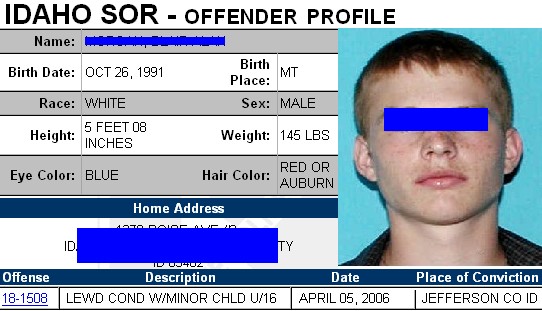
| Example registry entry, in this case of a juvenile |
A sex crime registry may be public, meaning its information is freely available, generally on the Internet, or access to it may be restricted to police and other government agencies. Some registries are part public and part restricted. For example, a 2006 analysis6 by National Public Radio showed that 23 states only provide public access to the listings of people who are considered dangerous or have multiple convictions, while in 25 states anyone convicted of a sex crime is shown on the public websites. Similarly, some states only show the listings of adult registrants, while others include juveniles on their websites. According to the Human Rights Watch report, all registries outside the US are restricted; only the US has public registries.
Sex laws generally require a person who has been convicted of a registrable crime anywhere to register him- or herself in any jurisdiction in which he or she lives, works, and/or goes to school, and to keep the registry record up to date. However, law enforcement agencies also have data on convicted individuals and if a person does not register as required, then his or her name will be put on the registry as noncompliant.
Almost all the people on the registry are adult men, although the number of women and juveniles on the registries is growing. Approximately one out of every 220 adult men in the United States is on the registry. (For proof of that number, see the SOLR report, Count Analysis of the US Registries.)
People, including children and adolescents, may be required to register for decades, or for life. The Human Rights Watch study found7 that 17 US states require lifetime registration for all sex crimes, no matter how minor.
Footnotes
1. See Status and latest developments in sex offender registration and notification laws by Elizabeth Pearson in National Conference on Sex Offender Registries, Bureau of Justice Statistics (US DoJ), April 1998 (Link), pg 452. Jacob Wetterling Crimes against Children and Sexually Violent Offender Registration Act, which is §170101 of the Violent Crime Control and Law Enforcement Act of 1994, US Congress, September 13, 1994 (H.R. 103-3355, Public Law 103-322).3. The funding penalty in §(f)(2)(A) of the Jacob Wetterling Act was “10 percent of the funds that would otherwise be allocated to the State under section 506 of the Omnibus Crime Control and Safe Streets Act of 1968 (42 U.S.C. 3765).” Text of the 1968 law (Public Law 90-351) is not available online. Historical records indicate that §506 was 42 USC 3766, not 3765 [FindLaw, LII]. In any case, both of those sections were part of a version of Chapter 46-V of Title 42 that was repealed in 1988 [same notes]. So it is not clear just what funds the 1994 Wetterling Act was referring to. The 2001 Brookings Institution report, Government’s 50 Greatest Endeavors, indicated that in the 1968 law, “Block grants were provided to the states, with $100 million in funding.” Ten percent of any state’s share of that amount would seem to be small compared to the cost of implementing a registry. Amendments may have increased the amount of funding at stake by 1994 or the states may have found themselves under intense political pressure [See Q&A # 46] to get on the registry bandwagon, independent of any financial penalty for not setting one up.4. Pam Lychner Sexual Offender Tracking and Identification Act of 1996, US Congress, October 3, 1996 (S. 104-1675, Public Law 104-236)5. No Easy Answers: Sex Offender Laws in the US by Sarah Tofte with research by Corinne Carey, Human Rights Watch, September 12, 2007, §I, Summary6. Murders Put Focus on Sex-Offender Registry Policies, All Things Considered, National Public Radio (U.S.A.), April 21, 2006 (Audio report)7. No Easy Answers: Sex Offender Laws in the US by Sarah Tofte with research by Corinne Carey, Human Rights Watch, September 12, 2007, §V, Sex Offender Registration Laws
Page posted on January 28, 2009.
Page copyright © 2009, SOL Research. All rights reserved.